Building Code Compliance: Faucet Flow Rates, Mounting Heights, and Sensor Placement

Building Code Compliance: Faucet Flow Rates, Mounting Heights, and Sensor Placement

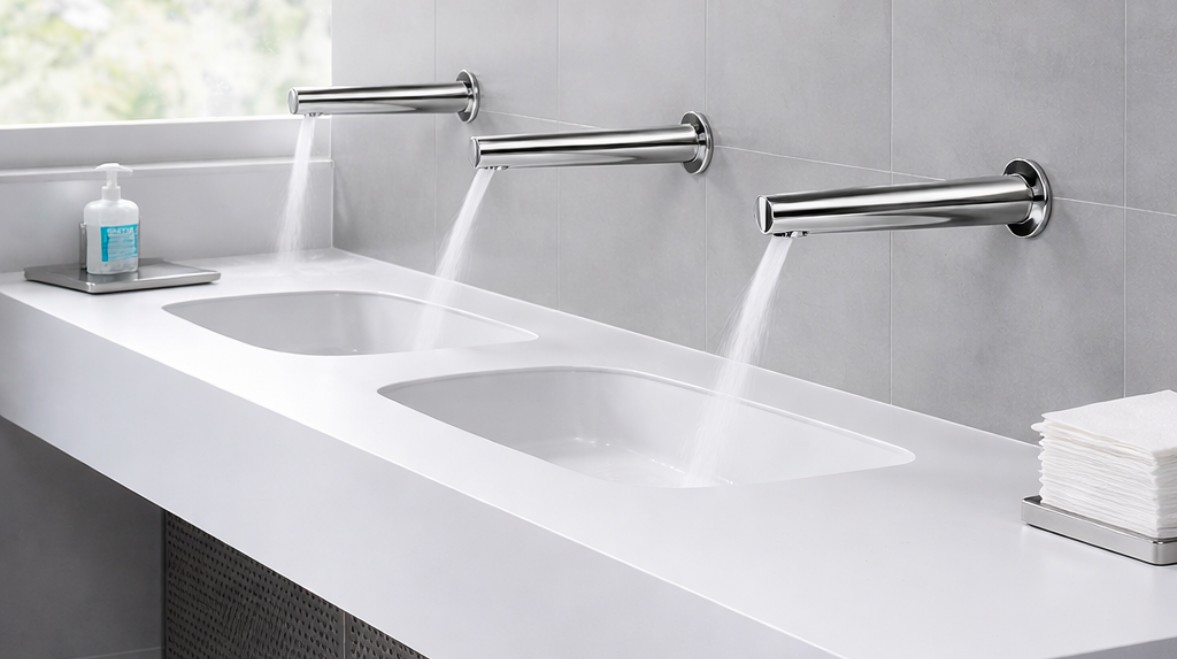
Building Code Compliance for Commercial Faucets + Fontana Glacier Series Product Collection Introduction In commercial restroom design, faucet compliance rarely determined by a single specification. Instead, it results from the combined interaction of plumbing codes, accessibility standards, and public health requirements. Faucet flow rates, mounting heights, and sensor placement must work together to meet regulatory … Read more

Architectural Plumbing Design: Specifying Toilet Faucets in Commercial Restrooms

Architectural Plumbing Design: Specifying Toilet Faucets in Commercial Restrooms

Architectural Plumbing Design: Specifying Toilet Faucets in Commercial Restrooms Commercial restroom faucet specification should support hygiene, accessibility, durability, water efficiency, and long-term maintenance. This complete layout combines the article content with the product showcase section in one clean WordPress-ready design. Toilet Faucets Within the Architectural Plumbing System In commercial restrooms, toilet-area faucets function as part … Read more

Compliance Overview: WaterSense and LEED Certifications for Commercial Toilets

Compliance Overview: WaterSense and LEED Certifications for Commercial Toilets

Practical Compliance Planning for High-Traffic Commercial Restrooms WaterSense, LEED, ADA, ASME, and CALGreen do not work in isolation. In real-world projects, fixture selection works best when performance, accessibility, and water use targets are reviewed together early in design. That approach reduces change orders, supports smoother approvals, and helps restrooms perform better over time. Why coordinated … Read more

Eco-Impact Study: How Commercial Toilet Faucets Support Water-Saving and Sustainability Goals

Eco-Impact Study: How Commercial Toilet Faucets Support Water-Saving and Sustainability Goals

How Commercial Toilet Faucets Support Water Saving and Sustainability Goals Commercial toilet faucets do more than control water flow. In high-traffic restrooms, they help reduce potable water use, support hygiene programs, improve user experience, and contribute to long-term sustainability planning across commercial and institutional buildings. Why Faucet Selection Matters in Sustainable Buildings In office buildings, … Read more

Noise, Flow, and Comfort Analyses for Faucet Systems in Public Restrooms

Noise, Flow, and Comfort Analyses for Faucet Systems in Public Restrooms

Noise, Flow, and Comfort Analyses for Faucet Systems in Public Restrooms Why Faucet System Performance Matters Commercial and institutional public-restroom faucet systems must do much more than supply water. They are expected to provide specified levels of engineering performance in noise control, hydraulic stability, ADA accessibility, water efficiency, serviceability, durability, and occupant comfort. The system … Read more

Hygiene Impact Study: Touchless Toilet Faucets in Healthcare and Food Service Facilities

Introduction Toilet-room lavatory faucets in healthcare and food service facilities are not just plumbing fixtures; they are control points in both infection prevention and water and energy use. For architects and engineers working on clinics, hospitals, long-term care, commercial kitchens, and food processing environments, the decision to specify touchless faucets must be grounded in standards, … Read more

Durability and Maintenance Report: Real-World Lifespan of Commercial Toilet Faucets

Durability-and-Maintenance-Report-Real-World-Lifespan-of-Commercial-Toilet-Faucets

Commercial toilet faucets (lavatory faucets in public and semi-public restrooms) are small components within a building system, but they sit at the intersection of plumbing performance, accessibility, energy, and hygiene. For architects, engineers, and specifiers, the central question is not just “Does it meet code?” but “Will it maintain performance over a 10–20 year service … Read more

Battery Life and Power Source Study: Energy Efficiency in Commercial Toilet Faucets

Battery Life and Power Source Study: Energy Efficiency in Commercial Toilet Faucets

Commercial sensor-operated faucets and flush valves are now standard in airports, hospitals, higher education, and other institutional restrooms. Yet in many projects, power architecture and battery life receive less attention than hydraulics or hardware durability. For high-use facilities, the choice between battery packs, low-voltage hardwire, or hybrid power architectures can have significant effects on lifecycle … Read more

Engineering Insights: Infrared and Capacitive Sensors in Heavy-Duty Commercial Faucets

Engineering Insights: Infrared and Capacitive Sensors in Heavy-Duty Commercial Faucets

Modern commercial and institutional restrooms treat sensor faucets as infrastructure, not fixtures. For architects and engineers, the choice between infrared (IR) and capacitive sensing is less about “touchless convenience” and more about reliability under abuse, coordinated integration with plumbing and electrical systems, and documented compliance with codes and standards (ADA, WaterSense, CALGreen, ASME/CSA). This article … Read more

Eco-Impact Study: Sustainability Benefits of Commercial-Grade Touchless Faucets

Eco-Impact Study: Sustainability Benefits of Commercial-Grade Touchless Faucets

Touchless faucets have moved from “nice-to-have” to baseline expectation in many commercial and institutional restrooms. For architects, engineers, and specifiers, the question is no longer whether to use sensor-activated fittings, but how to quantify their sustainability impact and integrate them correctly within performance-driven building designs. This article frames touchless commercial faucets as engineered components in … Read more