Noise, Flow, and Comfort Analyses for Faucet Systems in Public Restrooms
Why Faucet System Performance Matters
Commercial and institutional public-restroom faucet systems must do much more than supply water. They are expected to provide specified levels of engineering performance in noise control, hydraulic stability, ADA accessibility, water efficiency, serviceability, durability, and occupant comfort.
The system also interacts with the wider plumbing layout, sink geometry, maintenance access, water pressure conditions, and long-term operating costs. In high-traffic buildings, a faucet that looks good on paper may still create splash, noise, inconsistent flow, or service issues in daily use.
This is why faucet selection should be treated as a system decision rather than a single-fixture choice. The right specification supports user comfort, reliable performance, and easier upkeep over time.
Regulatory and Specification Context
Water Efficiency
WaterSense bathroom sink faucets have a maximum flow of 1.5 gpm at 60 psi and are designed to reduce water use while still maintaining practical performance. In many projects, WaterSense-certified products are selected to support water reduction goals and compliance targets.
Accessibility
ADA requirements affect faucet operability, reach range, and activation force. Commercial faucets must support one-hand use and avoid tight grasping, pinching, or twisting motions, especially in public and healthcare environments.
Mechanical Performance
ASME A112.18.1 / CSA B125.1 remains a common benchmark for durability, pressure performance, and lifecycle expectations in commercial plumbing fittings.
Key ADA Expectations for Faucet Design
- Operation with one hand
- No tight grasping, pinching, or wrist twisting
- Force to actuate not over 5 pounds
- Reach-range compliance for seated and standing users
- Consistent activation in busy public spaces
Noise in Faucet Systems — Causes and Mitigation
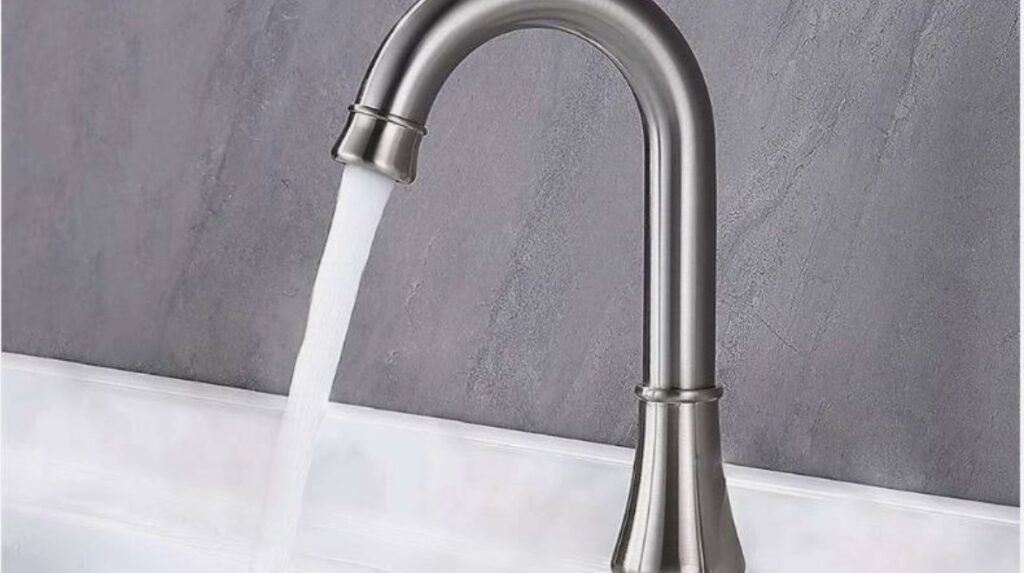
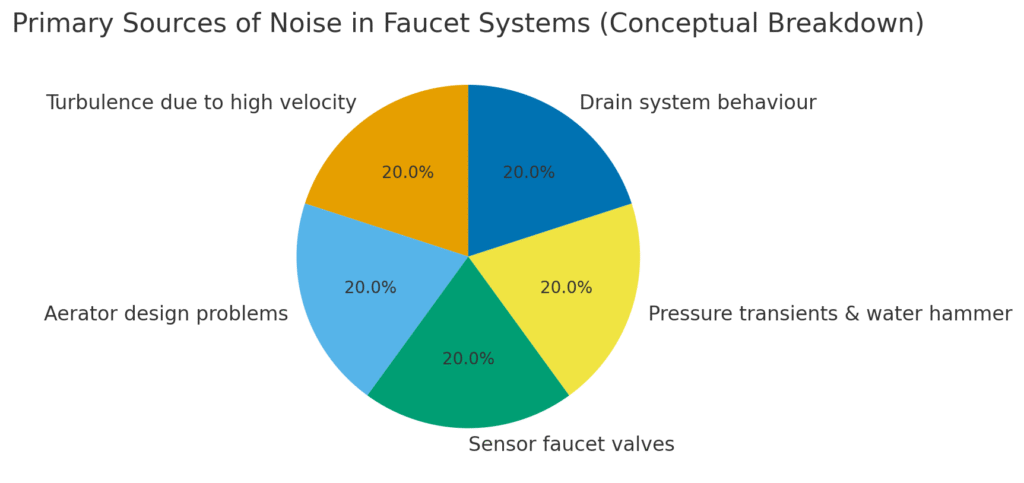
Acoustic performance is often overlooked in restroom plumbing design, yet excessive faucet noise affects occupant comfort and can reduce the perceived quality of a facility. The most common sources include hydraulic turbulence, fast valve action, unstable aeration, water hammer, and poor drain venting.
Primary Sources of Noise
- High flow velocity through narrow passages
- Aerator clogging or poor spray stability
- Sensor valve clicking or rapid opening
- Pressure transients during multi-fixture use
- Drain gurgling from poor vent performance
Practical Ways to Reduce Noise
- Use pressure-compensating aerators where pressure varies
- Specify slow-open and slow-close sensor valves
- Include hammer arrestors and pressure regulation upstream
- Prioritize smooth, controlled flow over maximum discharge
- Keep aerators easy to clean and replace
A quieter faucet system usually comes from better flow control, better pressure management, and better coordination between the faucet, sink, drain, and supply piping.
Flow and Comfort — Balancing Efficiency with Usability
Flow rate directly shapes user comfort, hot-water use, splash control, and drainage performance. Water-saving faucets can still feel comfortable when the stream is stable, properly aerated, and matched to sink dimensions.
WaterSense-certified faucets are designed to reduce flow volume, but usable performance still depends on pressure conditions, spout geometry, and how the stream lands inside the basin. In real-world settings, comfort often improves when the stream is controlled and predictable rather than simply stronger.
High-Use Building Considerations
- Variable supply pressure at peak occupancy
- Temperature-limiting devices for anti-scald protection
- Stable laminar or controlled aerated flow to reduce splash
- Drainage capacity that matches water-saving fixtures
- Long-term reliability of valves, solenoids, and aerators
New Addition: What Users Notice First
End users rarely judge a faucet by its certification sheet. They notice whether it turns on quickly, whether the stream feels too weak, whether it splashes onto clothing, and whether it shuts off cleanly without loud clicking or pipe noise.
For this reason, comfort in public restrooms is closely tied to response speed, stream shape, sink fit, and noise level.
Accessibility and Comfort in Faucet Operation
Accessibility supports both efficiency and comfort. Faucet designs must work for users with limited dexterity, mobility devices, or different reach conditions. Touchless models often support ADA goals because they remove the need for grasping or twisting.
Coordination with Sink Geometry
The faucet should be evaluated with the entire lavatory assembly, including clear floor space, knee and toe clearance, countertop thickness, spout reach, spout height, and splash-zone interaction with surrounding surfaces.
Durability and Long-Term System Integration
Durability matters in commercial restrooms because fixtures may see thousands of activations every week. Lead-free internals, corrosion-resistant alloys, dependable cartridges, and accessible service components all improve lifecycle value.
- Replaceable valve cartridges
- Accessible aerators
- Isolating shutoff valves at each fixture
- Service clearances below sinks
- Reliable parts support for maintenance teams
New Addition: Maintenance Issues That Affect Comfort
Comfort problems are not always design problems. In many facilities, poor user experience comes from deferred maintenance. A partially clogged aerator, a drifting sensor range, scale buildup inside the spout, or unstable supply pressure can change stream shape and increase noise.
Adding simple inspection routines for aerators, sensors, shutoffs, and supply pressure can help maintain consistent faucet performance without major system changes.

Systems-Level Coordination Checklist
| Performance Area | What to Review | Why It Matters |
|---|---|---|
| Flow Rate | gpm rating, pressure range, stream stability | Supports comfort, efficiency, and splash control |
| Noise Control | Aerator design, valve action, pressure changes | Improves acoustic comfort in busy restrooms |
| ADA Use | Activation force, reach, hand-free operation | Improves accessibility and ease of use |
| Sink Fit | Spout reach, height, splash zone, basin depth | Reduces mess and improves handwashing usability |
| Maintenance | Aerator access, cartridge replacement, shutoffs | Reduces downtime and service cost |
| System Integration | Supply pressure, venting, drainage, hot water | Prevents performance issues outside the faucet itself |
Balanced Specification Priorities
Specification of public restroom faucets involves balancing water efficiency, ADA accessibility, mechanical performance, acoustic control, maintenance access, and user comfort. No single feature determines long-term success on its own.
When flow rate, pressure conditions, aeration, ergonomics, and plumbing coordination are considered together, the result is a faucet system that feels better to use and is easier to manage over time.
This is the practical goal for commercial restroom projects: a faucet system that works quietly, delivers consistent performance, supports accessibility, and stays serviceable in demanding environments.
Conclusion
Effective design for faucet systems in public restrooms requires an engineering mindset, but it also requires attention to what occupants and maintenance teams experience every day. A high-performing system is not only efficient and compliant. It is also quiet, predictable, easy to use, and easier to keep in service.
When faucet selection is coordinated with sink geometry, plumbing pressure, maintenance access, and accessibility requirements, public restrooms become more resilient, more comfortable, and better suited to long-term commercial use.