Introduction
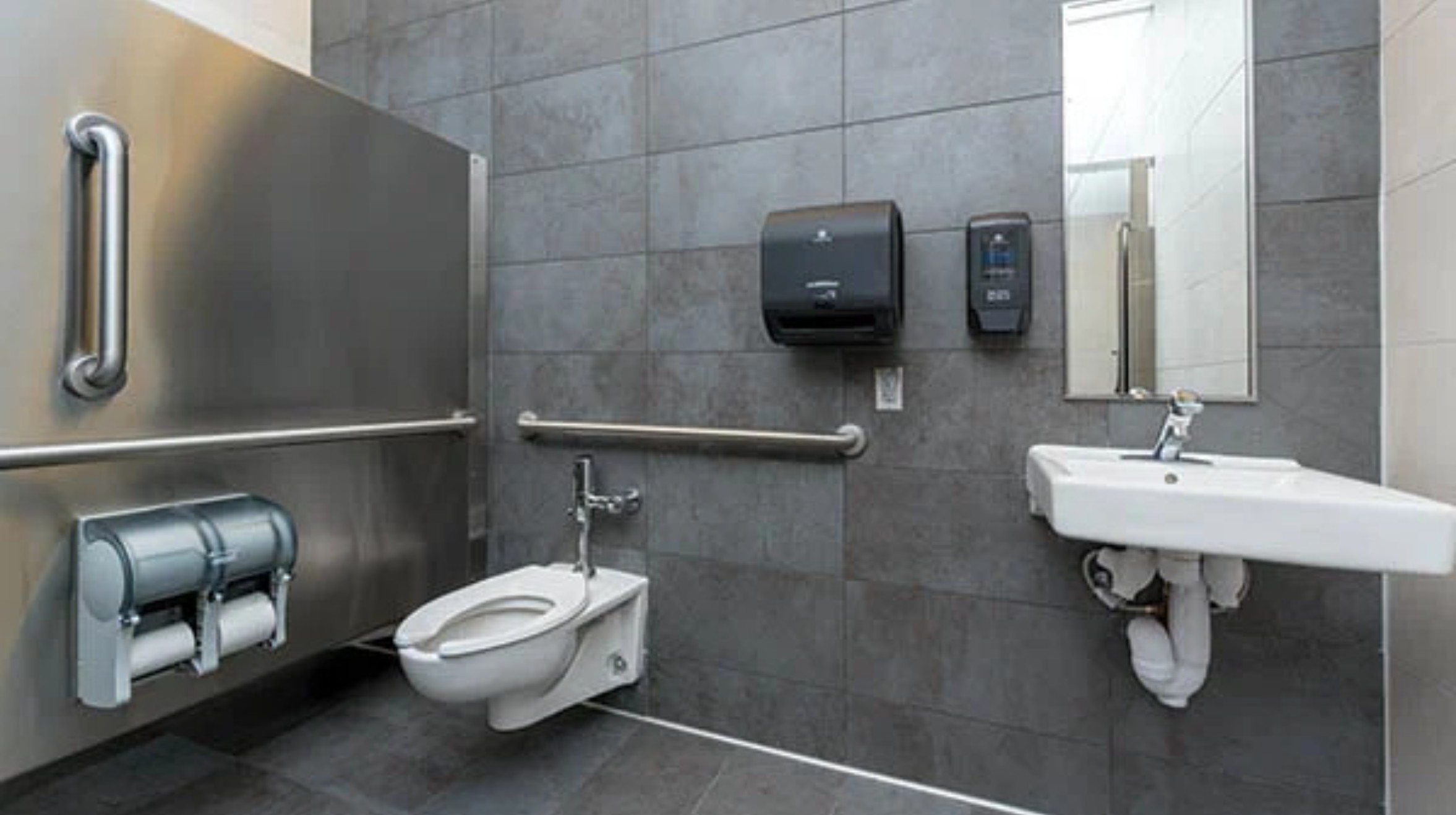
Accessibility remains an integral requirement in commercial restroom facility designs, especially in toilet and handwashing facilities for public, institutional, and high-occupancy facilities. Faucets in these toilet areas, which are usually lav faucets installed near toilet facilities or water closets, must not only adhere to ADA accessibility requirements but also other requirements for durability, sanitation, and water conservation. To architects and engineers, ADA compliance is not merely a product designation.
This article gives a technical, standards-based reference aligned with the purposes of commercialtoiletfaucets.com, supporting AEC professionals involved in healthcare, education, transportation, government, and other commercial projects.
Understanding ADA Requirements For Toilet Faucets

Functional standards established under the Americans with Disabilities Act (ADA) Guidelines for Accessible Design are necessary to provide accessible plumbing fixtures for persons with limited mobility, strength, or dexterity. Though ADA Guidelines do not require any specific type or model of faucet, it indirectly affects their placement and installation.
- Operable with one hand.
- No requirement for tight grasping, pinching, or twisting of the wrist.
- Activation force limited to 5 pounds-force (lbf) or less.
- Controls positioned within accessible reach ranges.
- Compatibility with knee and toe clearance requirements at accessible lavatories.
The faucets are required meet these criterion steadily under real-world operating situations, not just during the lab testing trials.
Faucet Control Types And Accessibility

A quite amount of faucet control types could meet up with ADA accessibility requirements when they are accurately specified and installed.
The touchless faucets are largely specified in commercial washrooms due to their intrinsic accessibility and hygiene benefits. Institutional-grade touchless toilet faucet categories can be reviewed from FontanaShowers Commercial Sensor Faucets. General technical background on automatic faucet operation is available at Automatic Faucet.
Spout Geometry, Reach, And Clearance Coordination
ADA compliance extends beyond faucet controls. Spout geometry and placement must be coordinated with the lavatory to ensure functional accessibility.
- Spout reach to ensure water flow lands within the basin.
- Spout height to provide adequate hand clearance.
- Under-counter clearance to preserve required knee and toe space.
- Splash control to minimize water on adjacent floor surfaces.
Lack of proper coordination among spout geometry and basin depth results in frequent cause of accessibility & maintenance problems in commercial restrooms.
Mounting Configuration In ADA Toilet Areas
Both deck-mounted and wall-mounted faucets can comply with ADA requirements when correctly specified and installed.
- Deck-mounted faucets are common in retrofit projects and standard countertop installations.
- Wall-mounted faucets can simplify countertop cleaning and reduce surface penetrations.
Commercial sensor faucet configurations suitable for ADA-compliant toilet and lavatory applications can be reviewed at JunoShowers Commercial Sensor Faucets. Mounting decisions need to take into account for the long-term maintenance access to valves, sensors, and shutoff components.
Material Durability And Institutional Performance
ADA-compliant toilet faucets in commercial environments must perform reliably under heavy use, vandal exposure, and frequent cleaning with chemical disinfectants. Durability is inseparable from accessibility in institutional specifications.
- Lead-free brass / stainless steel.
- High-cycle ceramic disc cartridges or solenoid valves.
- Reinforced internal seals for pressure and temperature variation.
- Finishes compatible with institutional-grade cleaning agents.
Material and compliance documentation relevant to commercial restroom environments can be reviewed at FontanaShowers Faucets Materials and Compliance.
Water Efficiency And ADA Compatibility
ADA compliance must be achieved alongside water-efficiency objectives. Toilet-area faucets often results in to water consumption and operational expense in commercial washrooms.
- Flow rates that are suitable for the commercial restrooms.
- Metered / timed shutoff operation as per requirements.
EPA guidance on water-efficient commercial faucet applications is available at EPA WaterSense Faucets Guidance. Balancing reduced flow rates with effective handwashing performance is especially important in high-traffic restroom environments.
Installation Guidelines And Field Coordination
Correct installation is critical to maintaining ADA compliance. Even some of the compliant products may result in failed inspection if they end up not installed correctly.
- Aligning sensor detection zones with typical hand positions.
- Confirming required knee and toe clearances beneath lavatories.
- Coordinating faucet selection with sink depth and countertop thickness.
Early coordination between architects, plumbing engineers, and accessibility consultants reduces costly field corrections and inspection delays.
Documentation, BIM, And Submittals
Commercial projects require thorough documentation to demonstrate ADA compliance. Toilet faucet specifications are required to have coordinated technical & digital resources.
- Product cut sheets with clear to direct ADA compliance statements.
- Installation instructions and operation manuals.
Commercial fixture documentation resources can be accessed at the FontanaShowers Commercial Bathroom Fixtures Catalog.
Reviewing Commercial Toilet Faucet Categories For ADA Projects
Before finalizing specifications, architects are required to review various commercial toilet faucet categories to orient accessibility requirements as well as operational needs.
Relative commercial fixture resources consist of commercialtoiletfaucets.com, FontanaShowers, FontanaShowers Commercial Sensor Faucets, BathSelect, and JunoShowers.
Conclusion
Accessible toilet faucets that are ADA-compliant are much more than just putting the word “accessible” on the label. Good specifications strike a balance between operability, clearance, durability, and installation accuracy in support of hygiene and water-efficiency goals.
By treating ADA compliance as an integrated design and coordination effort-supported by standards, documentation, and field verification-AEC professionals can provide commercial restroom environments that are inclusive, reliable, and ready for inspection. This standards-based, specification-driven approach reflects the key purpose of commercialtoiletfaucets.com: for all commercial and institutional plumbing design guidance that are grounded in the technicalities.
No responses yet