Commercial and institutional public-restroom faucet systems must do much more than supply water. They are expected to provide specified levels of engineering performance in noise control, hydraulic stability, ADA accessibility, water efficiency, serviceability, durability, and occupant comfort. The system interacts with other elements of the building infrastructure, plumbing design, and long-term maintenance strategies.
The following article provides an engineering-focused look at noise, flow, and comfort of public restroom faucet systems, referencing the ADA, WaterSense, CALGreen, and ASME performance standards utilized by the architect, mechanical engineer, and specifier.
Regulatory and Specification Context
Water Efficiency: WaterSense and CALGreen
The U.S. Environmental Protection Agency’s WaterSense program provides voluntary performance criteria for water-efficient faucets. WaterSense bathroom sink faucets have a maximum flow of 1.5 gpm at 60 psi and must meet performance criteria at a range of pressures. Reference document:
WaterSense Bathroom Sink Faucets Tech Sheet
WaterSense fixtures usually show approximately 30 percent water savings compared to the federal maximum flow rate of 2.2 gpm.
CALGreen – the California Green Building Standards Code – establishes water-efficiency requirements that are either mandatory or voluntary that will have a direct impact on the selection of fixtures in new construction. Overview reference:
CALGreen Compliance Overview
Specifiers seeking LEED or other environmental certifications usually opt for WaterSense-certified products because such products help achieve building water-use reduction goals.
Accessibility: ADA Requirements
ADA sets the accessibility specifications for operable parts and clearances to restroom fixtures. ADA Standards for Accessible Design specifies operability, reach range, and force limits. Reference:
ADA Standards for Accessible Design – Chapter 6
Some key ADA expectations for faucet design include:
- Operation with one hand
- No tight grasping, pinching, or wrist twisting
- Force to actuate, not over 5 pounds
- Reach-range compliance for seated and standing users
Additional background on ADA faucet selection is found at:
ADA-Compliant Faucets in Healthcare Settings – Symmons
How to Pick an ADA-Compliant Faucet – Chicago Faucets
Product Performance Standards: ASME A112.18.1 / CSA B125.1
Commercial faucets are typically specified to meet the ASME A112.18.1 / CSA B125.1 standard, covering material durability, flow performance, pressure limitations, and lifecycle requirements to ensure minimum thresholds for valve, aerator, seal, and all wetted component quality.
Many commercial fixture manufacturers detail their compliance and available BIM resources here:
Fontana Showers – Bathroom Fixtures
Noise in Faucet Systems — Causes and Mitigation
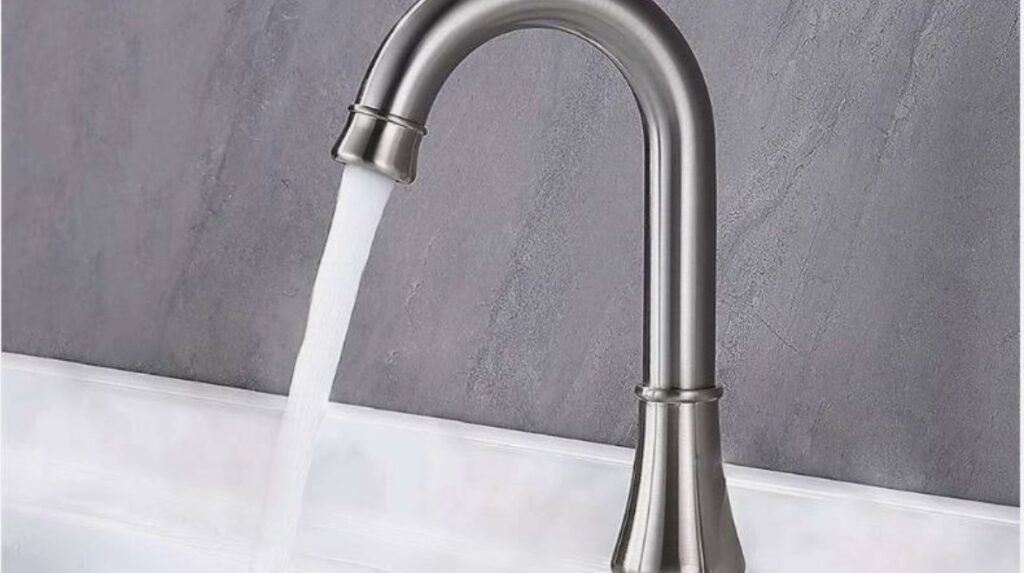
Acoustic performance is often neglected in restroom plumbing design, yet excessive noise affects the comfort of occupants and the perceived quality of a facility. Noise arises from hydraulic turbulence, aerator behavior, valve dynamics, and system-level plumbing interactions.
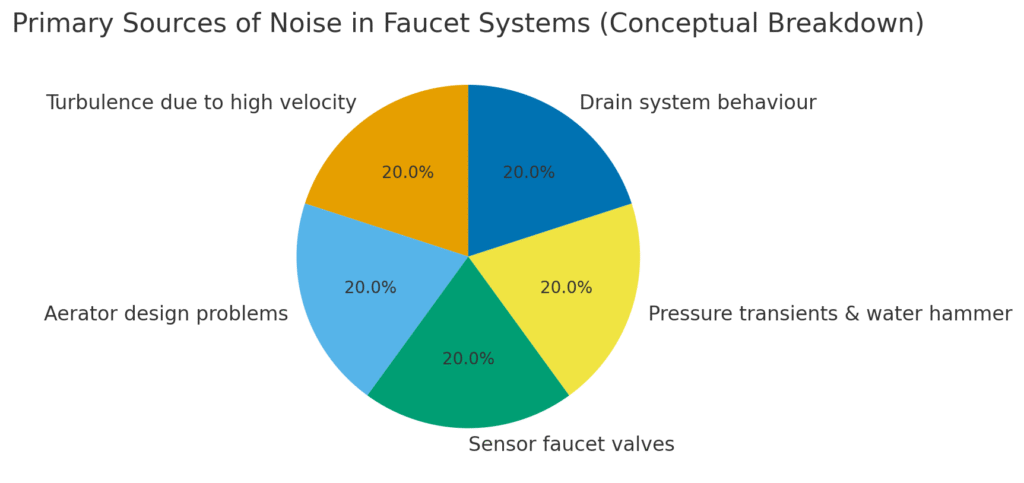
Primary Sources of Noise in Faucets
- Turbulence due to high velocity: Fast flow and narrow internal passages or high inlet pressure result in hissing and splashing.
- Aerator design problems: Poor aeration or clogged screens are responsible for noisy airflow and wavy spray patterns.
- Sensor faucet valves: The solenoid actuation can have both mechanical clicking and fast-opening acoustic pulses.
- Pressure transients and water hammer: Simultaneous use of multiple fixtures produces noise that is transmitted through pipes and at discharge points.
- Drain system behaviour: Poor venting generates gurgling or sucking sounds when water drains rapidly.
Engineering Development Strategies to Reduce Noise
- Pressure compensating aerators may be used where there is large variation in pressure.
- Specify slow-open/slow-close valves in sensor faucets to limit sudden changes in pressure.
- Hammer arrestors and pressure-regulating valves may be included in upstream plumbing.
- Smooth flow, not maximum flow, reduces turbulence while maintaining user comfort.
- Ensure maintenance access to clean the aerator since mineral buildup can increase noise and splash.
Noise control is most effective when addressed during schematic design, prior to a final determination of restroom layouts and plumbing branch systems.
Flow and Comfort — Balance of Efficiency and Usability
Flow rate strongly influences user experience, energy use (hot water), splash control, and drainage performance. This creates a challenge for designers to comply with water efficiency while sustaining a comfortable and functional hand-washing experience.
WaterSense Low-Flow Faucets
WaterSense-certified faucets greatly reduce flow volume but still must achieve the minimum required performance of 0.8 gpm at 20 psi in order to assure usability. Reference:
WaterSense Bathroom Sink Faucets Tech Sheet
WaterSense at Work, a companion guide for commercial facilities provides further technical guidance:
WaterSense at Work – Faucets Section
High-Use Building Considerations
Designers should consider:
- Variable supply pressure at peak occupancy
- Temperature-limiting devices that prevent scalding
- Stable laminar flow to reduce splash and enhance handwashing efficiency
- Drainage capacity when water-saving fixtures are combined with efficient toilets and urinals
- Long-term maintenance cycles including valve reliability and aerator replacement
ASME A112.18.1 / CSA B125.1 compliance assures mechanical durability, cycle testing and performance under commercial conditions.
Accessibility and Comfort in Faucet Operation
Accessibility supports both goals of water-efficiency and comfort: faucet designs must accommodate users with support devices for mobility, or with restricted dexterity.
ADA-Compliant Operation
ADA accessibility requirements for operable parts require low force to activate, without twisting motions, and with consistent activation. Reference details:
ADA-Compliant Faucets in Healthcare Settings – Symmons
How to Pick an ADA-Compliant Faucet – Chicago Faucets
ADA Standards for Accessible Design – Chapter 6
Often, touchless faucets support the ADA goals by getting rid of grasping and twisting.
Coordination with Sink Geometry
The faucet should function within the overall design of the lavatory, including:
- Clear floor space
- Knee and toe clearance
- Countertop thickness
- Spouting reach and height
- Splash-zone interaction with abutting partitions or mirrors
Many commercial fixture manufacturers provide BIM libraries that support proper dimensional coordination. Reference example:
Fontana Showers – Bathroom Fixtures
Durability and Long-Term System Integration
Durability is key in commercial bathrooms, where fixtures endure thousands of activations every week.
Materials and Lead-Free Requirements
The compliance of products to lead-free standards is usually documented by manufacturers along with other guidelines regarding materials. Example reference:
Pfister – Certifications
Specify faucets with lead-free internals, corrosion-resistant alloys, and high-cycle valve mechanisms.
Maintainability
High-traffic buildings require fixtures with:
- Replaceable valve cartridges
- Accessible aerators
- Isolating shutoff valves at each fixture
- Service clearances below sinks
Maintenance-friendly design reduces downtime, which in turn reduces the total lifecycle cost.
Systems-Level Coordination
Faucets connect with the whole plumbing system, including:
- Supply piping and pressure regulation
- Slope and venting, drainage
- Hot water distribution
- Water treatment considerations
- Facilities cleaning practices
Together, these factors ensure coordination of water efficiency, hygiene, and acoustics without sacrifice to reliability.
Achieving balanced specification priorities
Specification of public restroom faucets involves a balance between:
Water efficiency: WaterSense, CALGreen
Accessibility (ADA)
Mechanical Performance ASME A112.18.1 / CSA B125.1
Noise control
Access to maintenance
User comfort and flow stability
A systems-level approach considers how flow rate, pressure conditions, aeration, acoustic behavior, and ergonomics interact within the restroom environment.
Conclusion
Effective design for faucet systems in public restrooms requires an engineering mindset. By incorporating the latest standards for water efficiency, ADA accessibility, management of acoustics, and durability in products, architects and engineers can provide restrooms that perform both reliably and comfortably over decades of use. No single characteristic drives performance; rather, it is a function of hydraulic stability, user ergonomics, acoustics, sustainability, and maintainability. When thoughtfully coordinated, public restroom faucet systems become resilient, efficient, safe, and inclusive features of the built environment.
Condensed Summary Table
| Category | Key Points | Standards / References |
|---|---|---|
| Water Efficiency | WaterSense max 1.5 gpm; ~30% savings; CALGreen sets efficiency rules. | WaterSense, CALGreen |
| Accessibility | One-hand use; no twisting; ≤5 lb force; reach-range compliance. | ADA Standards |
| Mechanical Performance | Durability, flow stability, pressure limits, lifecycle testing. | ASME A112.18.1 / CSA B125.1 |
| Noise Sources | Turbulence, aerator issues, sensor valves, water hammer, drain venting. | Article discussion |
| Noise Reduction | Pressure-compensating aerators, slow-open valves, hammer arrestors, smooth flow. | Article discussion |
| Flow & Comfort | Min 0.8 gpm at 20 psi; stable laminar flow; anti-scald; drainage capacity. | WaterSense |
| Sink Coordination | Spout reach, height, clearance, splash control. | ADA + BIM resources |
| Durability | Lead-free materials; corrosion-resistant alloys; high-cycle valves. | Manufacturer certifications |
| Maintainability | Replaceable cartridges; aerator access; shutoff valves; service clearance. | Article discussion |
| System Integration | Supply piping, pressure regulation, hot water, drainage, cleaning practices. | Article discussion |
| Overall Priorities | Water efficiency, accessibility, performance, noise control, maintenance, comfort. | — |
No responses yet